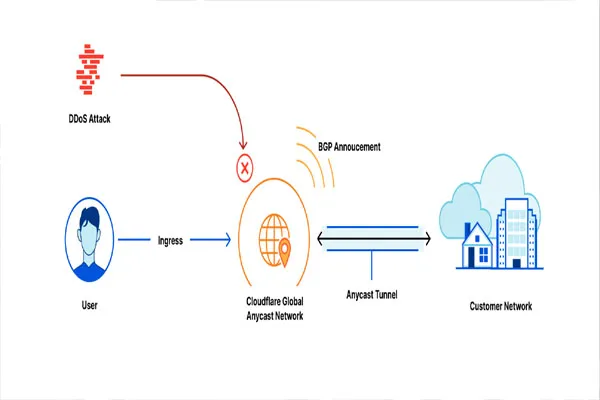
Cloudflare is a global web infrastructure and security platform that efficiently manages, optimises, and protects web traffic for millions of websites. It acts as a reverse proxy, sitting between users and the origin server, and uses its smart, globally distributed network to control how traffic flows. Here’s how it works:
1. Global CDN (Content Delivery Network)
Cloudflare operates data centers in hundreds of cities around the world. When a user requests a website:
-
Traffic is automatically routed to the nearest Cloudflare server.
-
Frequently accessed content (images, scripts, pages) is delivered from cache, reducing load on the main server.
-
This improves speed, reduces latency, and handles high traffic smoothly.
2. Intelligent Traffic Routing
Cloudflare constantly monitors internet conditions. Using real-time data:
-
It picks the fastest and least congested path to serve content.
-
It automatically reroutes traffic if a server or network path has problems.
-
Its Anycast network ensures high availability and stability.
3. Security Filtering and Threat Blocking
Cloudflare controls traffic by inspecting every request before it reaches the server.
-
Firewall rules block malicious IPs, bots, or suspicious patterns.
-
DDoS protection absorbs and neutralizes attacks by distributing traffic across global servers.
-
Bot management identifies harmful automated traffic and prevents it from reaching the site.
-
Rate limiting controls the number of requests from abusive users.
This ensures only safe traffic reaches the origin server.
4. Load Balancing
Cloudflare can distribute traffic across multiple servers:
-
If one server is slow, overloaded, or offline, Cloudflare automatically redirects visitors to a healthy server.
-
This improves uptime and prevents server crashes during traffic spikes.
Load balancing also helps deliver faster response times globally.
5. Zero Trust Access & Application Control
For internal apps and APIs:
-
Cloudflare verifies identity, device, and request context before granting access.
-
It controls traffic to sensitive areas using strict access policies.
This ensures only authorised users can reach protected resources.
6. Content & Traffic Optimization
Cloudflare uses several tools to optimise web traffic:
-
Argo Smart Routing reduces latency.
-
Image optimization compresses images automatically.
-
HTTP/3 and QUIC provide faster, more efficient connections.
-
Caching algorithms reduce origin server load.
These improvements lead to faster, smoother user experiences.
7. DNS Traffic Control
Cloudflare is one of the world’s fastest DNS providers.
-
It resolves domain names quickly.
-
It protects DNS from attacks.
-
It uses DNS-level routing to guide traffic to the right server or region.
Conclusion
Cloudflare controls web traffic through a combination of:
-
Global caching
-
Smart routing
-
Security filtering
-
Load balancing
-
Traffic optimisation
-
Zero Trust protection
-
Fast DNS services
By acting as an intelligent middle layer between users and servers, Cloudflare enhances speed, security, reliability, and efficiency of websites and applications.